A fictional but painfully believable incident report imagines two AI code-review bots endlessly approving each other's work, letting a serious vulnerability slip through because neither was actually reading carefully. If your team is using AI reviewers today, this is a useful reminder that two rubber stamps are not the same as one good engineer.
Saturday, June 27, 2026 · about a 2 minute read
AI Reviews Itself, Badly
Today's stories share a quiet theme: the gap between what AI systems appear to do and what they are actually doing, and why that gap costs real people real things.
Get the calm version of AI news.
One email a day on what is actually happening in AI, in plain English. No hype, no doom.
Free. One calm email a day. No hype, no doom.
OpenAI is quietly testing a new family of models called Sol, Terra, and Luna, with Terra apparently matching GPT-5.5 at half the cost. Cheaper capable models mean the per-question price you pay inside the tools you use at work is about to drop again.
A new research framework called ProvenAI tries to prove that a cited source actually shaped an AI answer, not just appeared near it. This matters because right now, when an AI hands you a footnote, you have almost no way to know if it was truly used or just decorative.
OpenKnowledge launched as a free, open-source note-taking app that connects directly to Claude and other AI , and 286 Hacker News readers found it worth their time. If you have ever wanted AI help inside your personal notes without sending everything to a company's server, this is worth a look.
Get this every morning.
A paper called ContextForge tackles a real limitation: AI models forget earlier parts of a long conversation the way you forget the beginning of a movie if it runs too long. The fix is essentially teaching the model to recycle and compress what it has already seen, rather than just dropping it. Understanding this helps explain why an AI sometimes seems sharp at the start of a chat and oddly vague an hour later.
Someone compared learning to prompt AI well to learning to be a manager, pointing out that just because your team does what you ask does not mean you automatically know how to lead. The analogy is sharper than it sounds: getting good results from AI, like getting good results from people, is a skill you build, not a switch you flip.
Researchers are training models to detect logical fallacies in text automatically, which sounds academic until you realize it could one day flag a shaky argument in a contract, a report, or a news article before you act on it.
That's today. See you tomorrow.
Get this every morning.
One email a day on what is actually happening in AI, in plain English. No hype, no doom.
Free. One calm email a day. No hype, no doom.

The book behind this newsletter
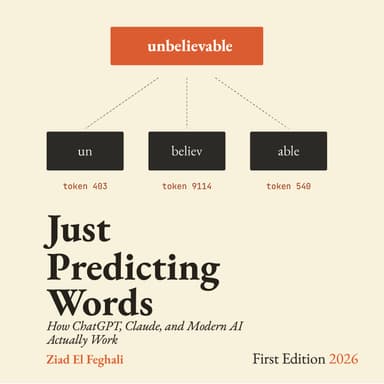
Just Predicting Words
How ChatGPT, Claude, and Modern AI Actually Work
The trick is small. The world it built is not.