A well-argued post is making the rounds about how cheap, capable models from China are squeezing the profit margins of every AI company. If the cost of intelligence keeps falling this fast, the business models that everyone built in 2023 are going to need a serious rethink, and that includes the price you pay for the tools you use at work.
Tuesday, July 7, 2026 · about a 2 minute read
Smaller, Cheaper, and Quietly Smarter
Today the story is not about one giant leap. It is about a dozen small bets that AI gets more useful when it gets leaner, more honest about what it does not know, and closer to where people actually live.
Get the calm version of AI news.
One email a day on what is actually happening in AI, in plain English. No hype, no doom.
Free. One calm email a day. No hype, no doom.
Tencent released Hy3, a 295-billion- model under an open Apache 2.0 license, meaning anyone can download and use it freely. More open, capable models mean more options for companies that do not want to be locked into one vendor, which is good news if you have ever felt stuck paying for something you could not inspect or control.
Small AI models are gaining real traction in places with unreliable internet, including hospitals and pharmacies in low-connectivity regions, because they can run on a single device without a cloud connection. This matters because it is a reminder that the most important AI deployments of the next decade may happen somewhere with no reliable signal, not in a San Francisco office.
Google released its Gemma 4 technical report, detailing a new family of models built for efficiency and reasoning, meaning they can handle text and images together. Open-weight models you can run yourself are getting seriously good, which changes the calculus for any team deciding whether to build on a closed API or host something locally.
Get this every morning.
Researchers found that LLMs are consistent, meaning they give the same verbal answer repeatedly, but miscalibrated, meaning the confidence in that answer does not match reality. Think of it like a friend who always sounds certain when giving directions but is wrong about one in four turns. Knowing this should change how much you trust an AI explanation of a risk or a probability, even when it sounds perfectly confident.
A new paper shows that frontier models can do multi-step reasoning using meaningless filler like dots, with no visible chain of thought that humans can check. It is a small, strange finding, but it raises a real question: if the thinking is hidden inside tokens that carry no words, how do we know what the model is actually doing?
OfficeCLI is an open-source tool that lets AI read and edit Microsoft Office files directly, which sounds mundane until you realize it means an AI can now touch the spreadsheet your whole team depends on. Worth keeping an eye on how quickly tools start reaching into everyday work files.
That's today. See you tomorrow.
Get this every morning.
One email a day on what is actually happening in AI, in plain English. No hype, no doom.
Free. One calm email a day. No hype, no doom.

The book behind this newsletter
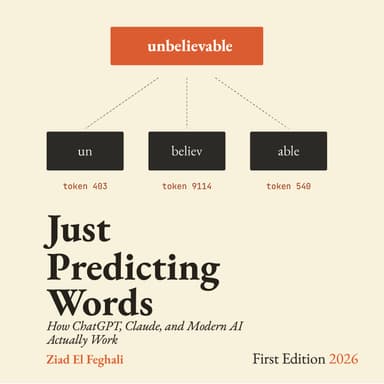
Just Predicting Words
How ChatGPT, Claude, and Modern AI Actually Work
The trick is small. The world it built is not.