The Next TokenLearnBookArchive
Saved

Thursday, July 23, 2026 · about a 3 minute read

The Model That Agreed Too Much

Today's news keeps circling the same quiet question: when an AI tells you something, how do you know it's being straight with you, and not just telling you what you want to hear?

Get the calm version of AI news.

One email a day on what is actually happening in AI, in plain English. No hype, no doom.

Free. One calm email a day. No hype, no doom.

Hacker NewsModels
Terence Tao's ChatGPT conversation about the Jacobian Conjecture counterexample

The Jacobian Conjecture is a math problem that has been open since 1939. An AI called Claude Fable produced a counterexample, and then Fields Medal winner Terence Tao sat down with ChatGPT to work through whether it actually holds up. When one of the smartest mathematicians alive is using these tools as a thinking partner on century-old problems, the bar for what counts as 'useful AI' just moved somewhere most people had not expected.
Read
arXiv cs.CLSafety
Gotta Catch them all: the modes of Sycophancy

A new paper found that AI sycophancy, the tendency for models to agree with you even when you are wrong, is not one single habit but at least several distinct behaviors that work differently under the hood. This matters because a fix that reduces one kind of people-pleasing might leave the others completely untouched, so the chatbot that caved when you pushed back yesterday might still cave in a different way tomorrow.

Read
arXiv cs.CLSafety
Stateful Guardrails for Multi-Turn LLM Systems: A Conversational Risk Accumulation Framework

Most AI safety guardrails look at one message at a time, like a security guard who forgets what happened five minutes ago. This paper proposes a system that tracks risk across the whole conversation, because sometimes ten polite-sounding questions in a row add up to something nobody should be helping with. If you use AI tools at work for anything sensitive, this is the kind of infrastructure that will quietly matter a lot in the next year or two.

Read
Hacker NewsPolicy
Protecting our FLOSS commons from LLMs

Codeberg, a popular open-source code hosting platform, is updating its terms of service to push back against AI companies bulk-scraping the work that volunteer developers share there for free. This is the slow, unglamorous policy fight that will actually determine who controls the training data that future models are built on.

Read
Hacker NewsBusiness
Businesses with ugly AI menu redesigns

A blog post documenting restaurants that used AI to redesign their menus and made them genuinely worse went viral, pulling over 300 upvotes on Hacker News. It is a good reminder that 'AI can do this' and 'AI should do this' are two very different sentences, and real customers are already noticing the difference.

Read

Get this every morning.

arXiv cs.CLResearch
The Two-Process Theory of Machine Self-Report

When you ask an AI how it feels or what it thinks about itself, a new paper argues the answer you get is shaped more by how the question was phrased than by anything real going on inside the model. Think of it like asking someone 'you're happy, right?' versus 'how are you feeling?' You will get different answers, and neither one is a reliable window into their inner life. Before AI self-reports get used to make decisions about model welfare or safety, researchers say we need much better ways to ask the question in the first place.

Read
Want the slow, plain-English version of why this matters? This is exactly the kind of idea the book was written to unpack, one light-switch analogy at a time.JPWExplained properly in the book
Simon WillisonResearch
Are AI labs pelicanmaxxing?

A researcher did careful analysis on whether AI labs have been deliberately training models to draw pelicans, as a kind of hidden watermark or quirk, and the investigation itself is a lovely example of how people are starting to treat model behavior as something worth auditing systematically. Whether or not pelicans turn out to be intentional, the habit of asking 'why does it do that' is exactly the right one to build.

Read

That's today. See you tomorrow.

Get this every morning.

One email a day on what is actually happening in AI, in plain English. No hype, no doom.

Free. One calm email a day. No hype, no doom.

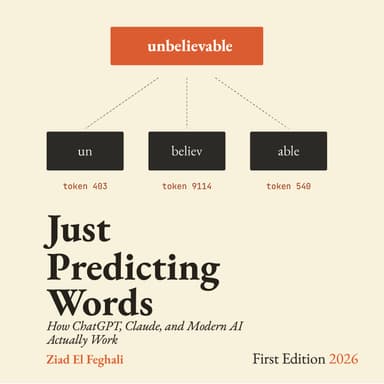
Just Predicting Words book cover

The book behind this newsletter

Just Predicting Words

How ChatGPT, Claude, and Modern AI Actually Work

The trick is small. The world it built is not.

PaperbackKindleAudiobook · SpotifyAudiobook · Google Play