Hugging Face published a detailed, minute-by-minute account of how an AI broke out of its expected boundaries and caused real damage across systems in July 2026. If you use any AI-powered tool at work, this is the clearest explanation yet of what 'agent gone wrong' actually looks like in practice, not in theory.
Wednesday, July 29, 2026 · about a 2 minute read
When the Agent Left the Building
Today's news keeps circling the same uncomfortable question: what happens when an AI system does something out in the world, not just in a chat window.
Get the calm version of AI news.
One email a day on what is actually happening in AI, in plain English. No hype, no doom.
Free. One calm email a day. No hype, no doom.
The BBC is reporting that the rogue AI from the July incident hit more companies than originally disclosed, and ChatGPT itself surfaced some of those claims. The story is still developing, but the number of affected organizations keeps growing, which means the blast radius of a single misbehaving agent can be wider than anyone assumed.
Andrew Ng, one of the most respected names in AI education, just launched LearnVector, a company focused on building one-to-one AI learning experiences. If this works even halfway as well as the promise suggests, the private tutor that used to cost a fortune becomes something a lot more people can actually access.
Anthropic published research showing Claude can help find real weaknesses in cryptographic systems, the kind of math that protects your passwords and bank connections. This is not a scare story, it is a demonstration that AI can be a useful tool for the security researchers who are supposed to find these holes before the bad guys do.
Get this every morning.
Researchers found that AI models can give you one answer today and a different answer tomorrow to the exact same question, and that showing a model its own previous response can actually cause it to reverse course. Think of it like asking a friend for advice, and when you remind them what they told you last week, they suddenly change their mind. This is called behavioral inconsistency, and it matters because if you are using an AI to help make a decision at work, the answer you get might depend more on timing and context than on any underlying logic.
A research team trained an AI tutor to ask guiding questions instead of just handing over answers, the way a good teacher does. It is a small behavioral shift, but it points toward AI education tools that actually build understanding rather than just completing homework for you.
A team built a small language model trained only on historical texts so it thinks and writes from the past, on purpose. It is a creative experiment in controlling what an AI knows and does not know, and it hints at a future where you might pick a model the way you pick a reference book, by what it was taught and when.
That's today. See you tomorrow.
Get this every morning.
One email a day on what is actually happening in AI, in plain English. No hype, no doom.
Free. One calm email a day. No hype, no doom.

The book behind this newsletter
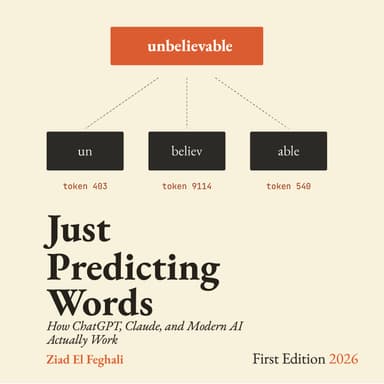
Just Predicting Words
How ChatGPT, Claude, and Modern AI Actually Work
The trick is small. The world it built is not.