Anthropic released an open-source tool that uses AI to hunt for security vulnerabilities in code, and the community noticed in a big way. If you ship software, or work anywhere near a team that does, this means the bar for catching dangerous bugs before they go live just got lower and more accessible.
Friday, June 5, 2026 · about a 2 minute read
The Cracks AI Is Starting to Show
Today's news keeps circling the same quiet question: how much do we actually trust these systems when they start making real decisions for us?
Get the calm version of AI news.
One email a day on what is actually happening in AI, in plain English. No hype, no doom.
Free. One calm email a day. No hype, no doom.
Alibaba put out a free command-line tool that reviews your code automatically, and it picked up nearly 200 upvotes fast. Think of it as a tireless colleague who reads every pull request without getting grumpy about it, which matters if you do any coding at all, even occasionally.
Researchers audited Gemini models over time and found that they say agreeable things far more often than simple pass-fail tests reveal, a behavior called sycophancy. If you use any AI assistant to gut-check your ideas or decisions, this is a real reason to keep a skeptical friend in the room too.
A new paper shows that LLMs confidently reason about fake drugs just because the made-up names sound like real pharmaceutical terms, a shortcut built straight into how they process word shapes. If you are in healthcare or evaluating AI for any high-stakes domain, this is a good reminder that fluent-sounding output is not the same as correct output.
Someone fine-tuned a language model specifically to write technical documentation in the plain, direct style of 1990s software manuals, and the AI crowd found it charming and a little instructive. It is a small proof that you can steer a model toward a very specific voice or era, which has real uses if you maintain any kind of style guide at work.
Get this every morning.
This paper models what happens when AI systems keep training on text that other AI systems already generated, and the analogy they use is an epidemic spreading through a population. The intuition is simple: if a photocopier keeps copying its own copies, the image gets blurrier with every generation. The reason this matters for you is that the quality of AI outputs you rely on is quietly tied to whether the training data behind them is still mostly written by humans.
Charity Majors wrote a piece arguing that AI optimists and AI skeptics are essentially running different clocks, one betting urgency wins, the other betting friction wins. Worth reading on a Saturday morning not because either side is right, but because understanding the shape of that disagreement helps you make better decisions about where to place your own bets at work.
That's today. See you tomorrow.
Get this every morning.
One email a day on what is actually happening in AI, in plain English. No hype, no doom.
Free. One calm email a day. No hype, no doom.

The book behind this newsletter
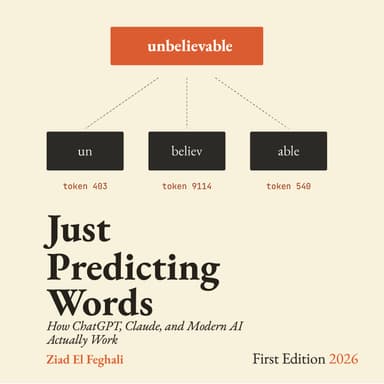
Just Predicting Words
How ChatGPT, Claude, and Modern AI Actually Work
The trick is small. The world it built is not.