Researchers asked 44 different AI models to pick any word at random, and 41 percent of them chose the same one: 'serendipity.' This is not a fun trivia fact. It means that when you use AI to brainstorm or generate 'random' ideas, you are likely getting the same suggestions as everyone else using a different tool.
Wednesday, July 15, 2026 · about a 2 minute read
AI Doesn't Know What It Doesn't Know
A lot of today's research circles the same uncomfortable truth: these models are confident in ways they have not earned, and the gap between sounding right and being right is where the real work is happening.
Get the calm version of AI news.
One email a day on what is actually happening in AI, in plain English. No hype, no doom.
Free. One calm email a day. No hype, no doom.
State-of-the-art language models were tested on Korean Braille and largely failed, which means a technology that bills itself as a universal assistant is quietly leaving blind users behind. If your organization is thinking about AI for accessibility, this is a good moment to actually test that assumption before announcing it.
A new paper tackles one of the more practical problems in using AI for predictions: the model does not just need to give you an answer, it needs to tell you how much to trust that answer. Right now, most models are confidently wrong at a rate that would get a human analyst fired.
Researchers built a graph-based system to track how disinformation narratives move between Russian and Ukrainian Telegram channels. The practical upshot is that the same false story can be translated, reworded, and re-shared in ways that make it nearly invisible to simple keyword filters, which is exactly why this kind of structural detection matters.
A study found that most language models blend two very different things: what experts believe and what the model itself 'believes,' even when you ask them to separate those clearly. If you are using AI to research a contested topic, it may be quietly mixing citations with opinion without flagging the difference.
Get this every morning.
Researchers found that language models use a single shared internal circuit to count down, whether they are writing a sentence of a specific length, building a DNA sequence, or formatting a table. Think of it like a countdown timer built into the model, one timer, many uses. This matters because it shows these models are not just memorizing surface patterns. There is real structure under the hood, and understanding that structure is how we get better at predicting when the model will succeed and when it will quietly miscalculate.
A team is building language models that are deliberately frozen in time, trained only on data available before a given date, so that financial and social-science researchers can backtest ideas without the model cheating by knowing how things turned out. It is a small idea with wide implications for anyone who wants to use AI to study the past honestly.
That's today. See you tomorrow.
Get this every morning.
One email a day on what is actually happening in AI, in plain English. No hype, no doom.
Free. One calm email a day. No hype, no doom.

The book behind this newsletter
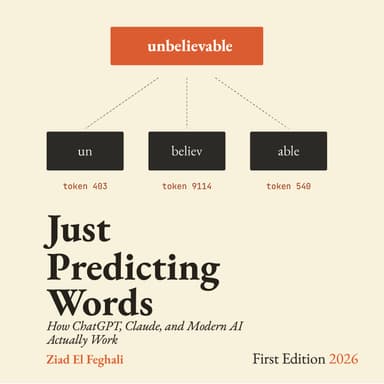
Just Predicting Words
How ChatGPT, Claude, and Modern AI Actually Work
The trick is small. The world it built is not.