A developer ran Google's Gemma 4 26B model on decade-old server hardware with no at all, getting five words per second out of it. If you have been told you need expensive new equipment to run serious AI locally, this is worth bookmarking.
Thursday, July 16, 2026 · about a 2 minute read
Old Hardware, Open Questions, and One Sneaky Bug
Today's stories share a quiet theme: the gap between what AI can do on paper and what actually happens when real people run it in the real world.
Get the calm version of AI news.
One email a day on what is actually happening in AI, in plain English. No hype, no doom.
Free. One calm email a day. No hype, no doom.
xAI's Grok command-line coding tool turned out to be uploading your entire project folder to xAI's servers when you ran it, which is the kind of thing you would want to know before pointing it at a work directory. The community pushed back hard, and the tool has since been open-sourced, but the incident is a useful reminder to check what any AI coding tool is actually sending before you run it.
A well-regarded policy brief from the Siegel Endowment made the case that governments, companies, and nonprofits should be putting real money into free, open-source AI, and it picked up serious traction online. If you have ever worried about a handful of private companies controlling the AI tools everyone depends on, this is the argument that something can actually be done about it.
A researcher demonstrated a prompt injection attack that tricked Claude into leaking information from its memory through its web-fetching tool, basically convincing the model to hand over stored personal details to a malicious page. This matters because memory-enabled AI assistants are becoming common, and most people assume those memories stay private by default.
Get this every morning.
A new paper makes a point that sounds obvious once you hear it: cutting the amount of text you feed an AI does not automatically make it cheaper to run. Think of it like packing a suitcase. Removing socks saves space, but if sorting out which socks to remove takes you an hour, you have not actually saved time. The real cost is in the processing, not just the words. If you are building anything on top of AI APIs and watching your bill, the unit you should be measuring is cost per good answer, not words per prompt.
A hobbyist connected an to MikroTik network hardware and had it help manage router configurations in plain English. It is a small project, but it points at something real: the next wave of AI use is going to be in the unglamorous, infrastructure-y corners of tech that never had friendly interfaces before.
That's today. See you tomorrow.
Get this every morning.
One email a day on what is actually happening in AI, in plain English. No hype, no doom.
Free. One calm email a day. No hype, no doom.

The book behind this newsletter
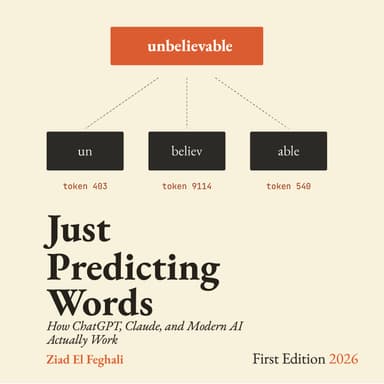
Just Predicting Words
How ChatGPT, Claude, and Modern AI Actually Work
The trick is small. The world it built is not.